

Posts Tagged ‘facultyresearch’
Digital Bat Twins – NeuroAI generates testable hypotheses about higher-level cognitive function
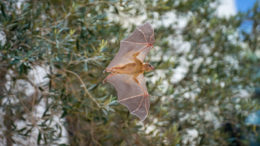
Researchers in Michael Yartsev’s lab, led by postdocs Adam Lowet and Krishna Kasuba, built a digital twin of the bat hippocampus – an AI model trained on large-scale neural activity during natural flight. The model generated new, testable hypotheses about hippocampal organization that were confirmed by real-world data.
Read MoreFrom bat flight to the most complex human movements

Examining large-scale neural activity from the motor cortex of freely flying Egyptian fruit bats helps Michael Yartsev’s lab understand how the brain supports very complex behaviors, like buttoning a shirt or playing piano.
Read MoreSolving a longstanding problem in drug delivery

Lipid nanoparticles are great delivery vehicles for mRNA treatments, but their positive charge triggers high levels of inflammation. Now researchers led by Professor Niren Murthy have engineered a new lipid nanoparticle that can switch its charge from positive to negative and may avoid triggering inflammation while still able to deliver mRNA and other nucleic acids.
Read MoreHow One Simple Change Can Make Lipid Nanoparticles Safer for Gene Editing and Other Applications

In a new paper out in Nature Nanotechnology, researchers in Niren Murthy’s lab show that there is a simple way to remove the toxicity of lipid nanoparticles while maintaining their ability to effectively deliver therapies to specific cells in the body.
Read MoreHerr Lab and partners receive grant to study biology in time and space
Our researchers have received a new grant from the Biohub non-profit research organization, looking to advance the field of Spatiotemporal omics – the ability to sample biomolecules at different locations and times to watch disease processes unfold. Amy Herr and her UCSF partners Jennifer Rosenbluth and Amrita Basu will be studying integrated organoid systems for immunotherapy toxicity.
Read MoreGrowing immune cells with more targeted cancer-fighting abilities

Recent research from Professor Derfogail Delcassian’s lab explores how the stiffness of swollen lymph nodes increases the strength, but decreases the precision, of cancer-killing immune cells.
Read MoreHerr wins Weill Neurohub Investigator Award
A research project on “the protein code of brain aging: from molecules to mechanisms,” by Professor Amy Herr has been selected for a Weill Neurohub Investigator Award. The Investigators program funds top faculty to form cross-campus, interdisciplinary teams to explore, create, and test bold new concepts and technologies.
Read MoreArkin Lab uses the microbiome to combat lung pathogens

Researchers from Adam Arkin’s lab, funded by a grant from the Dept. of Health and Human Services, have engineered colonies of good bacteria that can be inhaled to crowd out pathogenic bacteria and combat lung infections without antibiotics.
Read MoreNature provides the answers

An in-depth look at research by Professor Phil Messersmith, who draws on biology to develop cutting-edge materials for medicine. His lab creates adhesives and therapies designed to work with the human body, offering new ways to repair tissues, heal wounds and treat disease.
Read More